
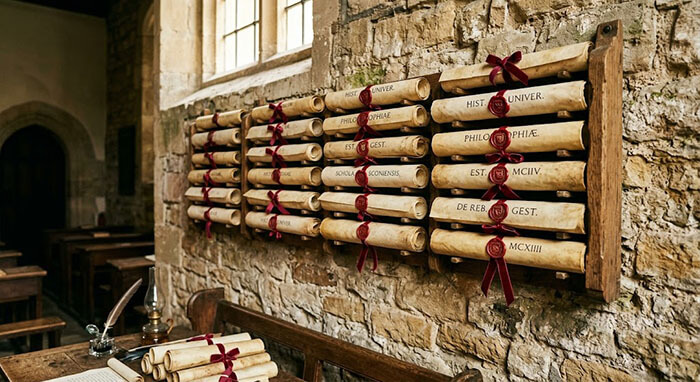
When you walk across a graduation stage and receive your hard-earned credential, you are participating in a tradition that spans nearly a thousand years. Today, we accept these paper rectangles as standard, but the look, feel, and design of the graduation milestone has undergone a wild historical transformation.
As we celebrate the launch of diplomafiles.com, let’s take an educational journey through the history of the academic document to understand why we still treat these sheets of paper with immense reverence today.
1. The Era of Sheepskin and Hand-Inked Calligraphy (1100s – 1700s)
In the medieval universities of Europe, paper was incredibly rare, fragile, and expensive. To ensure an important decree could last for generations, institutions printed credentials on vellum or parchment—which was actually made from stretched, treated animal skins (usually sheep or calves).
-
The Style: Every single sheepskin document was completely unique. A master scribe spent days writing out the Latin text by hand using a quill pen.
-
The Seal: To prove legitimacy, a large ball of colored beeswax was melted directly onto the bottom of the skin and stamped with the university’s metal ring symbol.
2. The Industrial Revolution and Massive Book Diplomas (1800s)
As printing technology advanced with the invention of steam-powered presses, sheepskin gave way to heavy cotton paper. However, because a university degree was still incredibly rare, the documents were massive—often resembling large, foldable blueprints.
To make them easier to transport, schools began placing these large sheets inside luxurious, leather-bound book folders or folding cases. Graduates carried these heavy leather books like modern portfolios to show prospective business partners or local councils.
Medieval Era  -> Stretched Sheepskin Vellum -> Hand-Written Latin Calligraphy
Victorian Era -> Oversized Cotton Blueprints -> Stored in Heavy Leather Portfolio Books
Modern Era    -> Structured Grid Layouts   -> 3D Gold Foil Seals & Sharp Serif Fonts
3. The Modern Era of Grid Symmetry and Clean Authority
By the mid-20th century, the academic world embraced clean, structured geometry. Universities abandoned massive, unwieldy book sheets in favor of standardized sizing (like 8.5″ x 11″ or 11″ x 14″).
Authority was no longer conveyed through sheer size or messy animal skins, but through typography balance, clean margins, and sophisticated security details like metallic hot-foil stamps.
Celebrate Your History with DiplomaFiles
Understanding the deep history of document design shows that a credential is never “just a piece of paper”—it is an heirloom of human effort.
If your original achievement document was damaged by an accident, or if your school issued a cheap, uninspiring print that doesn’t do justice to your hard work, visit our design catalogue. At DiplomaFiles, we combine historical reverence with premium modern materials to recreate your achievements with true academic prestige.
👉 Honor Your Educational Journey. Explore Custom Templates at DiplomaFiles.com!