
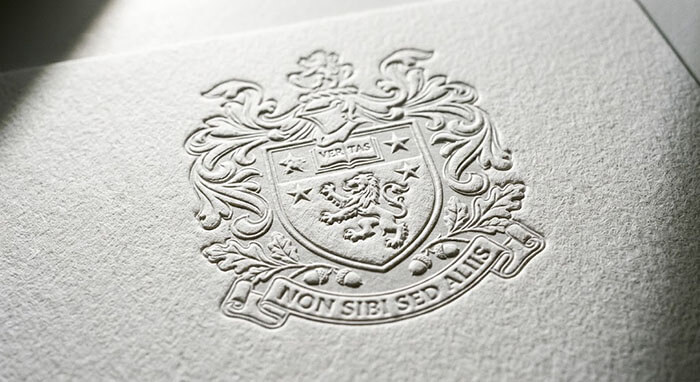
Unlike hot-foil stamping—which uses brilliant reflectivity to catch the eye—blind embossing relies entirely on form, light, and shadow. By pressing un-inked paper between matching male and female dies, blind embossing creates a physical 3D relief that rises directly out of the paper sheet.
However, achieving a dramatic, deep emboss without fracturing brittle paper fibers is a delicate balance of metallurgy, pressure, and paper selection.
At diplomafiles.com, we engineer custom sculptural embossing dies for institutional seals. Here is how we balance depth, fiber elasticity, and sheet flatness.
1. Male/Female Counter-Die Micro-Fit
Deep blind embossing requires two complementary dies: a raised brass male die and a recessed female matrix:
-
Clearance Calibration: The gap between the male punch and female cavity must exactly match the compressed thickness of the paper stock.
-
Beveled Relief Edge: Sharp $90^\circ$ die edges will cut paper like a knife. We carve die walls with a smooth $10^\circ$ to $15^\circ$ bevel angle to stretch long cotton fibers gracefully without tearing.
Sharp 90° Edge Die (Standard Stamp) ──> Tears paper fibers ──> Rough, fractured edges
Beveled 15° Relief Die (DiplomaFiles) ──> Stretches fibers smoothly ──> Crisp, structural 3D relief
2. Paper Fiber Length and Moisture Dynamics
Standard wood-pulp cardstock has short, stiff fibers that snap under heavy pressure. We exclusively use 300+ GSM 100% cotton rag stock. Long cotton fibers naturally stretch around deep die contours, holding crisp, dimensional relief that will not flatten over time—even inside protective archival sleeves.
Give Your Seals Sculptural Depth
Transform flat seals into tactile works of art. Explore our blind embossing finishing options and custom die manufacturing at diplomafiles.com today.