
Watermark Engineering: Embedded Paper Security from Wet Pulp to Finished Charter

In an age where high-resolution printers can duplicate printed surface patterns with startling accuracy, true security must be embedded inside the physical structure of the paper itself. Surface-printed “watermarks”—such as light gray ink printed on the back of a page—offer weak protection and can be easily scanned. A true paper watermark is created during the […]
Precision at $0.5\text{ pt}$: Engineering Micro-Text in Metallic Hot-Foil Stamps

Micro-printing—text printed so small that it requires a magnifying glass or loupe to read—is a standard security feature on banknotes and passports. Traditionally, micro-text was limited to offset lithography or high-resolution ink printing. Stamping micro-text in metallic hot-foil, however, presents an extreme physical challenge. Molten foil tends to bridge across micro-cavities, filling in the loops […]
Layered Defense: Balancing Overt and Covert Security Features in High-Value Documents
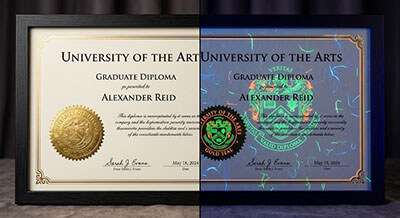
When designing high-value certificates, diplomas, or legal charters, reliance on a single security element—such as a simple gold sticker—leaves the document vulnerable to modern high-resolution scanning and forgery. Effective document authentication relies on a layered security architecture: combining features visible to the naked eye with hidden features requiring specialized equipment to verify. At diplomafiles.com, we […]